On August 1, 2025, Reza Pahlavi announced that “experts” had drafted a transition plan for Iran under his supervision, published through NUFDI, the document is marketed as a roadmap to democracy.
However, structural analyses by Dr. Majid Rafizadeh, Professor Kazem Kazerounian, and Fateh Saeidi (TISHK Center for Kurdistan Studies) argue that the plan reproduces centralized authority rather than dispersing it.
Instead of dismantling authoritarian structures, the framework reorganizes them.
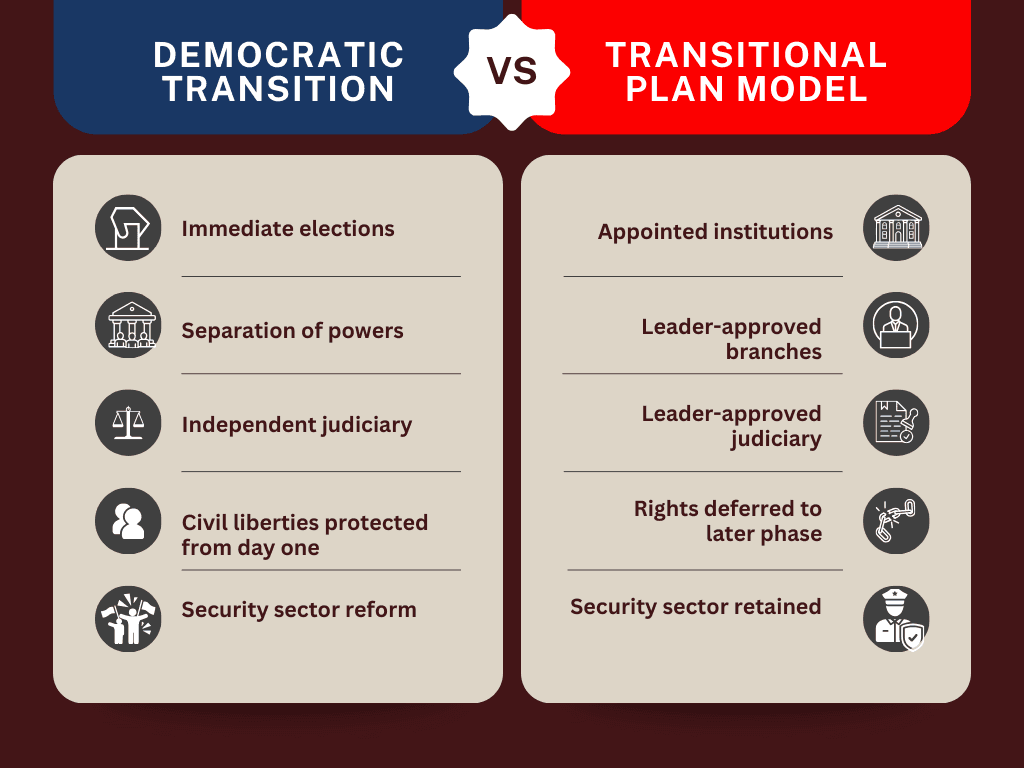
Reza Pahlavi’s transitional plan describes a political model that concentrates power in a single unelected authority and weakens democratic institutions. Key features include:
At least three years of one-person rule with expanded executive authority
Appointments, not elections: leadership of government branches and even legislative seats are hand-picked
Abolition of parliament and replacement with an elite council (“Mahestan”)
Martial law proposed across 20 major cities
Retention of existing coercive bodies (including cyber-policing and special security units)
Continuation of strategic military programs (nuclear, missile, and drone development)
Heightened repression risks for Iran’s ethnicities and communities, including Baluch and Kurdish groups
Continuation of current regime laws during the transition period
Rebuilding monarchy-era security institutions such as SAVAK and the Imperial Guard
I. One Unelected Leader Above All Institutions
The plan establishes a “Transition System” composed of:
National Uprising Body (Legislative)
Transitional Government (Executive)
Transitional Court (Judiciary)
All operate under the authority of the “Leader of the National Uprising.”
As outlined in the Emergency Phase document (Section 3, para. 3–4), the heads of all three institutions require approval by the Leader. Legislative members are appointed rather than elected.
Professor Kazerounian describes this as a structural collapse of separation of powers at the very moment when democratic safeguards should be strongest.
Similarly, Rafizadeh characterizes the model as one in which institutional legitimacy flows downward from a centralized authority rather than upward from citizens.
What the “Transition Framework” Structurally Constructs
The Transitional Government is formed without elections:
The head of government is appointed.
Ministers are selected through internal approval mechanisms by the leader.
Government structure remains subject to leadership consent.
Martial law is explicitly authorized in 20 major cities.
According to Kazerounian, emergency authority in the plan is not meaningfully time-bound, and executive power precedes democratic legitimacy.
Rather than embedding consent, the framework prioritizes stabilization through centralized control.
II. Executive Power Without Electoral Mandate
The Transitional Court’s leadership is appointed through the same centralized mechanism.
Judicial authority remains structurally dependent on executive approval.
Intelligence coordination in enforcement is authorized during the emergency phase.
Kazerounian warns that without institutional insulation, the judiciary cannot serve as an independent check.Rafizadeh further notes that transitional justice mechanisms under centralized control risk becoming instruments of consolidation rather than accountability.
III. A Judiciary Subordinated to Executive Authority
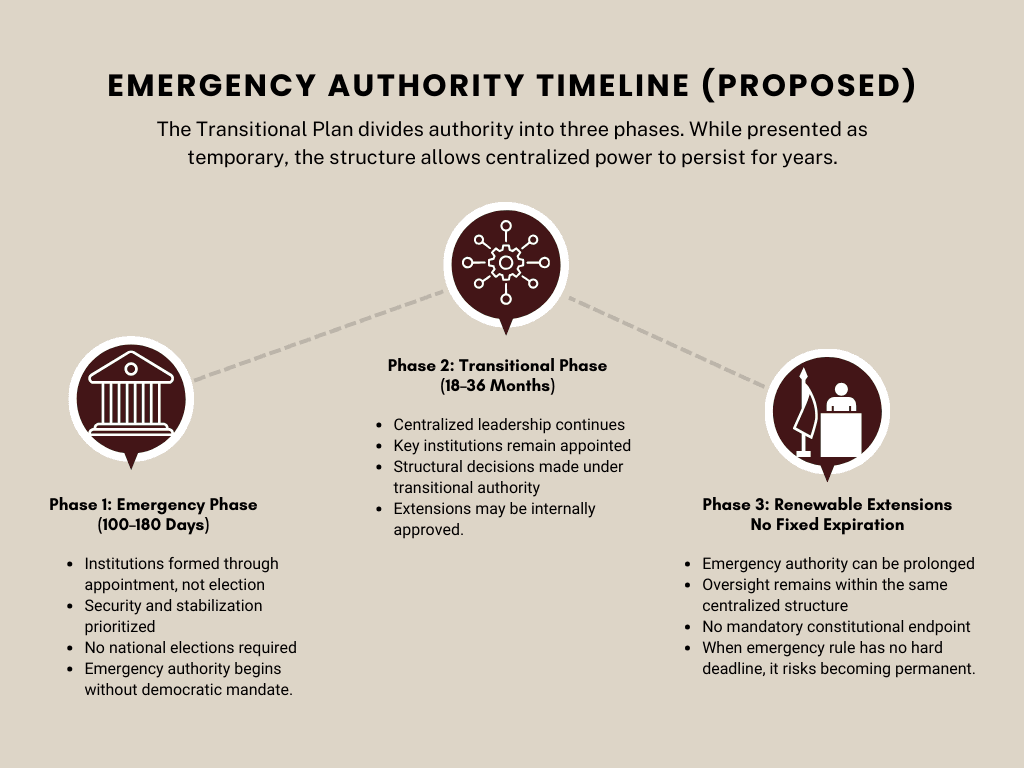
IV. Renewable Emergency Rule Without a Hard Endpoint
The transitional period is defined as:
18–36 months
Extendable internally
Confirmed by leadership authority
Extensions of emergency authority can be renewed through internal mechanisms, with no fixed constitutional expiration.
Kazerounian argues that this creates a pathway by which temporary emergency governance may normalize and extend indefinitely.
Control over time becomes control over political structure.
The transitional period is defined as:
18–36 months
Extendable internally
Confirmed by leadership authority
Extensions of emergency authority can be renewed through internal mechanisms, with no fixed constitutional expiration.
Kazerounian argues that this creates a pathway by which temporary emergency governance may normalize and extend indefinitely.
Control over time becomes control over political structure.
V. Preservation of Security Structures
The plan explicitly includes:
Retention and vetting of IRGC personnel
Continued intelligence structures
Special enforcement and anti-riot units
Seizure or control of national broadcasting
Rather than dismantling coercive institutions, the framework restructures and retains them.
Rafizadeh characterizes this as a reconfiguration of authoritarian tools under a new leadership framework.
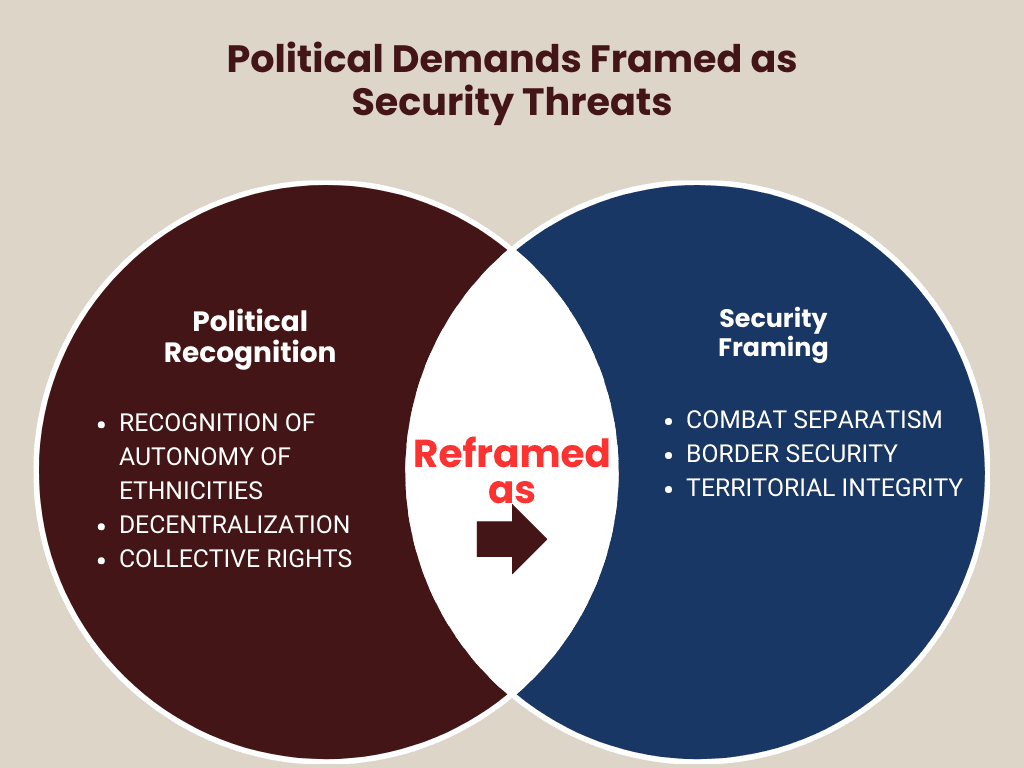
VI. Ethnic Diversity Framed as a Security Issue
One of the most consequential silences concerns Iran’s multi-national reality.
The plan:
Frames “separatism” and regional mobilization as security concerns
Offers no decentralization or federal framework
Provides no recognition of collective political rights for non-Persian peoples
Saeidi argues that the document treats ethnic identity primarily through the language of threat rather than rights. Diversity is acknowledged culturally but not institutionally.
The political future is limited to centralized models, while alternative constitutional arrangements — such as federalism or regional autonomy — are excluded from consideration.
Concerns have hightened in this regard after statement by Reza Pahlavi threatening Iran’s ethnicities, the same people who fought the regime from the outset, branding them separatists and threatening force.
VII. Democratic Safeguards Deferred
Absent from the framework:
Immediate elections during the emergency phase
Binding civil liberties protections from day one
Judicial independence insulated from executive influence
A non-renewable deadline for centralized authority
Absolute safeguards limiting coercive power
Kazerounian concludes that the plan governs first and legitimizes later.
Saeidi further notes that transition is framed as administrative stabilization rather than collective political founding.
Rafizadeh describes the resulting structure as resembling a centralized, leader-dominated model rather than a pluralistic democratic transition.
Conclusion
Reza Pahlavi’s Transitional Plan is presented as a democratic bridge.
Yet, according to independent academic analyses:
Authority consolidates before participation begins.
Institutions are appointed rather than elected.
Emergency governance is renewable.
Security structures are preserved.
Political pluralism is deferred.
The central question is not whether the plan promises democracy.
The question is whether its institutional architecture prevents authoritarian restoration — or structurally enables it.
Resources
Rafizadeh, Majid (2025). Reza Pahlavi’s Platform: A Roadmap to Neo-Fascist Rule
Kazerounian, Kazem (2026). Reza Pahlavi’s Blueprint for Dictatorship.
Saeidi, Fateh (2026). Reza Pahlavi’s Transition Plan: How a Non-Democratic Roadmap Reproduces Authoritarian Power in Iran. TISHK Center for Kurdistan Studies.
Want a copy? Download now.
V. Preservation of Security Structures
The plan explicitly includes:
Retention and vetting of IRGC personnel
Continued intelligence structures
Special enforcement and anti-riot units
Seizure or control of national broadcasting
Rather than dismantling coercive institutions, the framework restructures and retains them.
Rafizadeh characterizes this as a reconfiguration of authoritarian tools under a new leadership framework.
V. Preservation of Security Structures
The plan explicitly includes:
Retention and vetting of IRGC personnel
Continued intelligence structures
Special enforcement and anti-riot units
Seizure or control of national broadcasting
Rather than dismantling coercive institutions, the framework restructures and retains them.
Rafizadeh characterizes this as a reconfiguration of authoritarian tools under a new leadership framework.
V. Preservation of Security Structures
The plan explicitly includes:
Retention and vetting of IRGC personnel
Continued intelligence structures
Special enforcement and anti-riot units
Seizure or control of national broadcasting
Rather than dismantling coercive institutions, the framework restructures and retains them.
Rafizadeh characterizes this as a reconfiguration of authoritarian tools under a new leadership framework.
VI. Ethnic Diversity Framed as a Security Issue
One of the most consequential silences concerns Iran’s multi-national reality.
The plan:
Frames “separatism” and regional mobilization as security concerns
Offers no decentralization or federal framework
Provides no recognition of collective political rights for non-Persian peoples
Saeidi argues that the document treats ethnic identity primarily through the language of threat rather than rights. Diversity is acknowledged culturally but not institutionally.
The political future is limited to centralized models, while alternative constitutional arrangements — such as federalism or regional autonomy — are excluded from consideration.
Concerns have hightened in this regard after statement by Reza Pahlavi threatening Iran’s ethnicities, the same people who fought the regime from the outset, branding them separatists and threatening force.